Blog author
About meMaks Hapchuk
Web Analyst, Marketer
Maks Hapchuk
Web Analyst, Marketer







Wed, April 1, 2026
Mobile app analytics lives its own separate life, while website analytics lives its own. And no one seems to care that in the modern world a user might visit a website and then, just 15 minutes later, continue interacting with the brand in the app. Today’s tip is about how to avoid this situation and set everything up correctly.
Read more
Fri, February 27, 2026
When a business has multiple websites — for example, a main website or brand blog and a separate e-commerce store on different domains — analysts face a challenge. How can you understand that a user who came from an ad to the blog and then made a purchase in the store is the same person? This is exactly the problem that cross-domain tracking solves.
Read more
Wed, October 15, 2025
Last week, the Google Ads team presented Google Ads MCP. For me personally, it was one of the most anticipated updates of this autumn (yes, there have been unofficial MCPs for Google Ads for quite some time, but the official one is still the official one — and it marks the real move of Google’s team in this direction). This news quickly spread across news groups and chats — both among those working with advertising and within analytics communities. However, apart from the announcement itself, I haven’t seen a single example of practical use.
Read more
Thu, July 24, 2025
Although ChatGPT appeared less than three years ago, it has already significantly changed how we behave online. More precisely, not only ChatGPT, but LLMs in general: Gemini and Claude, of course, have also contributed greatly to this shift in behavior. And I believe that the market hasn’t yet fully appreciated the contribution of Anthropic (the developers of Claude). After all, they were the ones who came up with the Model Context Protocol (MCP), which we’ll be discussing today.
Read more
Thu, June 19, 2025
After reading the title of this piece, you might ask: “Why even do this in the first place?” Why not just send data directly to GA4 via Measurement Protocol? Why involve Server-Side GTM at all? The short answer: as always, using Google Tag Manager — whether client-side or server-side — helps reduce the workload for developers. The full answer will become clear as you read on.
Read more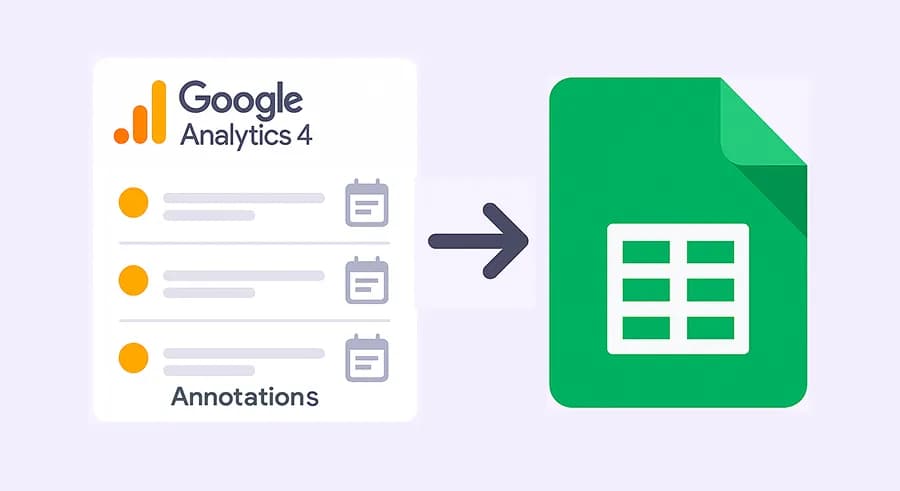
Mon, June 2, 2025
This article, like many others on this blog, appeared by chance — thanks to a question in the chat. Last week, in our private PRO ANALYTICS course chat, Lena Kolisnyk asked: “Is it possible to export annotation data from GA4 into Google Sheets so that it can later be used in custom reports?” Neither I nor the students recalled a ready-made solution. However, about a month ago on LinkedIn — and later in our internal ProAnalytics.Team chat — I came across a solution by Tamás Geiger that allows you to automatically create annotations in GA4 when publishing versions in GTM using Google Apps Script.
Read more
Fri, September 6, 2024
We all know how to draw conclusions from structured data to some extent, but most people get lost when asked to analyze unstructured data. Today, I’ll try to take a closer look at this process.
Read more
Thu, August 1, 2024
Last week, the Google BigQuery team rolled out an exciting update called Table Explorer, designed to help analysts — and anyone else working with BigQuery — tackle their tasks more easily and conveniently. In short, this feature allows you to quickly explore table data in a user-friendly visual way and even write simple SQL queries.
Read more
Wed, December 20, 2023
This post came about accidentally, but I hope it’ll be useful to many marketers during these pre-holiday days. Today, Dima Osiuk and I were discussing the landing page for the SERVER-SIDE GTM BASICS course and thought it would be great if the promo code could be prefilled in the form automatically whenever possible.
Read more
Thu, May 11, 2023
People tend not to trust new things. And when switching from Google Analytics Universal to Google Analytics 4, they start comparing the data in both systems. As a result, they notice that the same metrics have different values. This applies to almost all metrics in both platforms — be it the number of users, sessions, key events, or even the key event rate. The values will differ between the two systems, and the first thing you need to understand is — IT’S NORMAL FOR THEM TO BE DIFFERENT.
Read more